
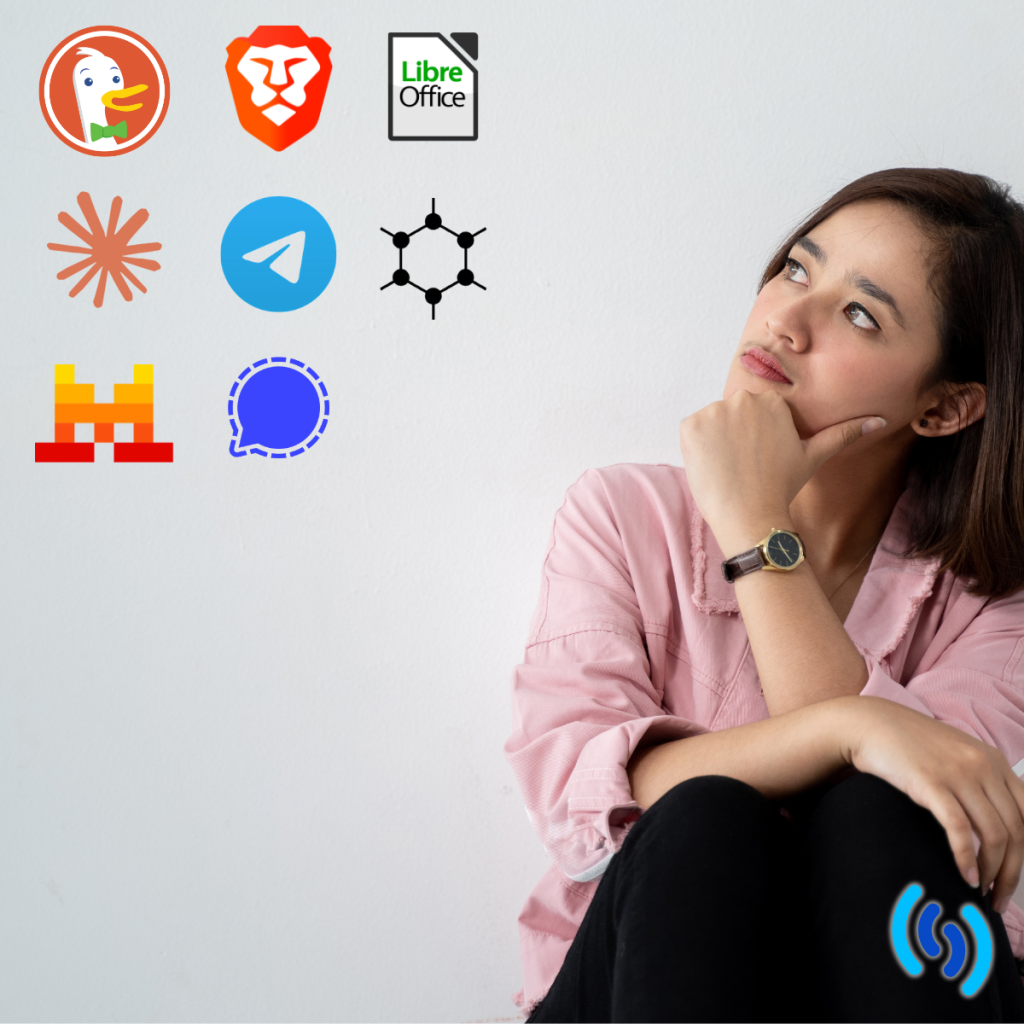
In our previous article, we explored the idea that technology choices are increasingly becoming ethical choices. Instead of focusing only on price, features, or popularity, more people — including businesses choosing mobile platforms and workplace software — are asking deeper questions about the tools they use every day.
- Who builds this technology?
- What happens to our data?
- What values do the companies behind these tools represent?
Once those questions enter the picture, the next logical step is obvious: what alternatives actually exist?
There is no perfect choice, and every option comes with trade-offs. But if you’re curious about making different choices, there are several interesting alternatives worth exploring.
Ethical AI Tools Businesses Can Consider
Artificial intelligence has quickly become one of the most visible areas where ethics and technology intersect. Concerns range from how AI systems are trained to how they might be used by governments or corporations. Environmental impact is also part of the conversation, as the data centres that power AI systems consume large amounts of electricity and water for cooling.
If you’re exploring alternatives in the AI space, a few notable options include:
Claude (Anthropic) – Claude has gained attention for its strong emphasis on AI safety and responsible deployment. Anthropic often frames its approach around building systems that behave predictably and are less likely to be misused.
Mistral AI – European AI company aiming to build powerful language models while strengthening Europe’s technology ecosystem. Its models are increasingly used in European businesses and research projects.
Privacy-Focused Messaging Apps for Teams
Messaging platforms are one of the hardest technologies to change because they rely on network effects: if all your friends are on one app, switching isn’t easy. Still, some alternatives focus heavily on privacy and security.
Signal – Signal is widely considered one of the most privacy-focused messaging apps available. It uses strong end-to-end encryption and collects very little user data. The platform is run by a non-profit foundation. It’s widely used by journalists, activists, and privacy-conscious users, and in recent years has also gained a growing mainstream audience.
Telegram – Telegram is popular for group chats, channels, and communities. While its encryption model differs from Signal’s, it remains a widely used alternative to mainstream messaging apps. Because most chats are stored in Telegram’s cloud, users can log in and out across multiple devices and keep access to their conversations.
Matrix / Element – For those interested in decentralised technology, Matrix is an open protocol for messaging that allows different servers to communicate with each other. Apps like Element use this system to create a federated messaging network. It’s often used by open-source communities, developers, and organisations that want more control over their communication infrastructure.
Productivity Software Alternatives to Microsoft Office
Office tools are an area where alternatives have existed for decades. If you’re looking to move away from platforms like Microsoft Office or Google Workspace, a couple of options stand out.
LibreOffice – One of the best-known open-source productivity suites, LibreOffice includes tools similar to Word, Excel, and PowerPoint. Importantly, it can open and save files in Microsoft Office formats, making it easier to collaborate with others who still use Microsoft tools.
For many users, switching office software is one of the easiest technology changes to make.
Privacy-Focused Search Engines
Search engines shape much of our online experience, but they also collect significant amounts of data about user behaviour. Some alternatives aim to reduce tracking and improve privacy.
DuckDuckGo – DuckDuckGo focuses on privacy by avoiding personalised tracking and user profiling. Searches are not linked to individual users.
Startpage – Startpage delivers Google search results while removing identifying information, acting as a privacy layer between the user and Google.
Brave Search – Developed by the makers of the Brave browser, Brave Search aims to build an independent search index rather than relying on larger search providers.
Smartphones and Hardware
Ethical considerations around hardware tend to focus on manufacturing conditions, environmental impact, repairability, and device lifespan — all factors that matter for businesses managing fleets of mobile devices. One of the most prominent examples in this space is:
Fairphone – Fairphone designs smartphones with sustainability and repairability in mind. Parts like the battery, screen, and camera can be replaced easily, extending the lifespan of the device. The company also works to improve transparency in its supply chain. Read our review of the Fairphone here.
Another approach is keeping existing hardware but changing the software.
Privacy-focused Android systems such as GrapheneOS allow users to run Android phones with reduced reliance on Google services.
European Alternatives and Digital Sovereignty
Some ethical technology discussions focus less on privacy and more on geopolitics.
Across Europe, policymakers and technologists have begun promoting the idea of digital sovereignty — reducing reliance on a small number of large global technology companies. Directories such as European Alternatives (european-alternatives.eu) list software and services developed or hosted in Europe, including alternatives to tools like Google Docs, Slack, and Dropbox.
The aim isn’t necessarily to abandon global technology companies entirely, but to encourage a more diverse and resilient technology ecosystem.
For businesses choosing mobile devices, communication platforms, and productivity software, these considerations are becoming increasingly relevant. Organisations are starting to look not only at cost and functionality, but also privacy policies, environmental impact, and the long-term sustainability of the technology they deploy.
The Reality: There’s No Perfect Choice
Even when alternatives exist, switching isn’t always simple. Your workplace might rely on Microsoft software, your friends might all use WhatsApp. The most convenient tools are often the ones people already know. For most people, ethical technology choices come down to priorities. Some users care most about privacy. Others focus on sustainability, geopolitics, or open-source software.
In the end, the idea that “tech has a conscience” doesn’t mean there’s a single correct answer. But the growing number of alternatives means that people now have more ways than ever to choose technology that aligns with their values.
Related articles:



If you’d like to talk through your current setup or get a quote for business mobiles, VoIP or broadband, give Simpatico a call or an email, and we can find the best tariffs and deals for you, with 5* customer service as standard.